
Zen, Nudity, Jumping Pigs...
And the Challenges of Preventive Medicine

UPDATED: May 7, 2026
Welcome to the Healthy Living Is Good Medicine Newsletter, presenting timely, science-based, original articles covering a wide range of preventive medicine and public health topics, along with critical commentaries on the politics and economics of the American healthcare system.
Zen and the Art of Medicine
Dr. Howard P. Lewis was one of my medical school’s most highly esteemed professors. He excelled at teaching second-year students the art of taking a medical history and performing a physical examination. Dr. Lewis described the challenge that we would face as future doctors as “seeing what you are looking at, hearing what you are listening to, and feeling what you are touching.”
I heard those words as if they were being delivered by a Zen Master. It struck me as a directive to “be here, now” with my patients. That’s what inspired me to take up meditation as a mental discipline. It was all too easy to get lost in “head-trips” about the differential diagnosis. I wanted something that would anchor my focus where it belonged; on the patient.
What I learned was that ten seconds of deliberately paying attention to my breathing, while letting my mind relax into a sound, instead of being distracted by thoughts, enabled me to give patients the attention they deserved. It also allowed me to listen more carefully to the meta-messages (from facial expressions, body language, tone of voice, etc.) and to use all of my senses to make more in-depth observations.
I’ve previously written about mindfulness, a quality of awareness that is both non-interpretive and attentive to a present-moment awareness of our sensory, cognitive, and emotional experiences. Meditation refers to a variety of contemplative practices and cognitive training methods that are intended to focus attention, increase awareness, and improve related mental abilities.
Meditation is historically associated with mystical traditions and spiritual disciplines that aspire to higher states of consciousness, often involving ego-dissolution and transcending conceptual dualities. There are now secular meditation programs, such as Mindfulness-Based Stress Reduction (MBSR), that have direct applications for patient care.
The Evolution of Bedside Medicine
I learned the art of the history and physical (H&P) before automated lab tests and CT scans, more than a half-century ago. We would even do some of the tests ourselves, if we needed faster results. Our now-antiquated radiographs required large photographic films that had to be chemically processed and dried before they could be read.
In those days, primary care physicians had hospital staff privileges so they could provide continuity of care for their hospitalized patients. Today, hospitalists, who’ve never met the patient prior to their admission, are employed by hospitals to provide “more efficient” in-patient medical care. Unlike the emergency department dramatized in the award-winning series, The Pitt, when working on the front lines of medicine we had little to go by, besides what patients could tell us, and what we could observe for ourselves.
The H&P is now in danger of becoming a lost art, with AI-summarized patient interviews and an abundance of data from rapid lab tests and imaging studies. All-too-brief appointment slots, higher patient volumes, and the medical-legal requirements necessitating electronic medical records collectively reduce healthcare providers’ quality time with their patients.
A detailed patient interview and complete physical exam has something of a luxury. Now, the H&P is often performed by a Physician Assistant or Nurse Practitioner. Consequently, medical students are learning to rely more upon diagnostic testing, and less upon conclusions drawn from the H&P.
Despite the “time is money” economic pressures against it, the H&P remains a foundational skill set for clinical practice. A well-taken history alone could account for 80 percent of correct diagnoses in an internal medicine clinic, according to a 1975 analysis. Professor Lewis would often tell us, “If you listen carefully enough, and ask the right questions, the patient will almost tell you their diagnosis.”
A complete medical history includes the patient’s chief complaint, a history of their present illness, past medical and surgical history, current medications, allergies, family history, social history, a review of systems, preventive care and health maintenance (immunizations, cancer screenings, risk-factor monitoring, and functional status (especially for older or chronically ill patients). Strong evidence supports the history of present illness as the single, highest-yield diagnostic element. As a patient, make sure that your provider gets this vital information.
In real-world applications, the H&P is not “complete." Rather, it is optimized for a specific context. What works best in the emergency department will be different from a primary care or specialist’s evaluation. In any setting, an accurate clinical assessment will determine what tests are most appropriate, and guide their interpretation. Over-reliance on testing adds to medical expenses, and introduces risks of false positives, irrelevant findings, invasive procedures, and unnecessary exposure to radiation.
While the relative weight given the H&P in medical decision-making has shifted, it remains an important part of our patient interactions. Giving the patient one’s undivided attention is not just a diagnostic tool. It also helps develop our “medical intuition,” especially for those of us who have the inclination to be mindful, reflective, and introspective.
Being fully present with someone builds rapport, which can in itself produce therapeutic benefits. Never underestimate the power of the placebo. When a patient feels listened to and cared for, the healing process has already been set in motion. That’s what enables “alternative” practitioners with good interpersonal skills to side-step science-based medicine and still get results, at least some of the time.
The Emperor Was Naked
My career-long passion for preventive medicine was partly the result of my father’s untimely death, just before I entered medical school. He had a deadly combination of central obesity and high blood pressure, typical of the metabolic syndrome. His doctor told him that he would have to change his eating habits and lose weight if he wanted to live to a ripe old age.
My father, whose life was, for the most part, consumed by work, replied, “But doctor, eating is one of the few pleasures I have in life.” At the age of 60, he suffered a massive stroke while dining with a client, remained comatose, and died from pneumonia 10 days later.
The intern assigned to his case learned from my mother that I would soon become a medical student, so he talked at length about the pathophysiology of my father’s stroke and its prognosis. He shared a wealth of information about diagnosing and treating stroke victims, but nothing was said about how to avoid becoming one.
During my earliest interactions with patients as a medical student, it soon became apparent that many of their ailments had something to do with their lifestyles. So, I asked Professor Lewis about behavioral interventions aimed toward the prevention of strokes, cardiovascular disease, and cancer.
I was shocked and dismayed when he told me that the economic incentives in medicine revolve around treating illnesses, not preventing them. For me, it felt like suddenly recognizing that the “Emperor” that was “American Medicine” was stark naked, much as in The Emperor’s New Clothes, a popular children’s fable by Hans Christian Andersen.
At that time, preventive medicine primarily focused on improving sanitation and personal hygiene, encouraging immunizations, and detecting diseases sooner. Physicians did not actively promote interventions such as smoking cessation and dietary modifications. Many of them were poor role models for a healthy lifestyle. It wasn’t until 1971 that television and radio ads for cigarettes were banned, and preventive medicine gained some momentum.
As a medical student, it seemed painfully obvious that for many of the chronic illnesses I had been seeing, specific lifestyle-focused recommendations could potentially have a decisive impact. Rather than a vague “You need to lose some weight,” a diet and exercise plan with clear, incremental goals, might have saved my father’s life.
My profound disillusionment with the profit-oriented healthcare system precipitated my taking a year-long leave of absence, during which I traveled to East Africa. After reading about the medical work of Dr. Albert Schweitzer, I was hoping to find something in Africa that would inspire me through the long years of training that lay ahead.
Although my path never took me back to Africa, what I learned there motivated my return to medicine and solidified my future roles in preventive medicine, health education, and as a patient advocate. Those are roles that I’ve been unable to shake, even after retiring from active practice.
Allow Me to Digress
Near the end of my career as a practicing physician I served as the Medical Administrator at Kalaupapa Settlement on the Hawaiian Island of Molokai. While there, my wife and I rescued a feral Polynesian piglet (Sus scrofa) that had fallen through a cattle grate. With a touch of irony, we named her “Luau.”
She bonded with us, much as dogs become attached to the people who feed them. Except that pigs are smarter, and more stubborn (aka “pig-headed”), which can make them harder to train. We had tried returning Luau to the local sounders (family groups), but she apparently didn’t like the way the other pigs smelled, and always came running back to us.
As a youngster, Luau’s 15 minutes of fame arrived when she was featured on the Honolulu evening news in her new role as the mascot of Kalaupapa’s volunteer fire department, of which I was a member. TV news crews had flown in to cover the blessing of the new fire engine and firehouse provided by the National Park Service.
Although generally fastidious, because pigs have very few functional sweat glands for thermoregulation, they must rely upon external cooling methods, such as wallowing in mud. Aside from avoiding heat stress with evaporative cooling, mud serves as a sunscreen and insect repellent.
In Hawaii, feral pig wallows become rain puddles in which mosquitoes breed. Avian malaria, transmitted by the Culex quinquefasciatus mosquito, has been devastating Hawaii’s native forest birds, particularly the rare honeycreepers. Pigs and mosquitoes are both invasive species, and conservation efforts are aimed at their eradication. I make no excuses, except that our special piglet was no longer wild and threatening the ecosystem.
Although we had trained Luau to go on walks with a halter and leash, it took both of us hanging on to keep her from laying waste to the resident priest’s vegetable garden on our way to the beach where she liked to play. One day, a nearly blind patient encountered us walking Luau and remarked, “That’s the ugliest dog I’ve ever seen.” We didn’t tell him she was a pig, and soon rumors about “Doc’s ugly dog” were spreading through the community.
It was a Kalaupapa tradition to drive to the tip of the peninsula by the lighthouse and watch the sunset, before going home for dinner. Some of the patients and resident staff who would gather there were accompanied by their dogs. Much like the dogs, Luau enjoyed going for rides and poking her head into the wind.
Jumping Pigs
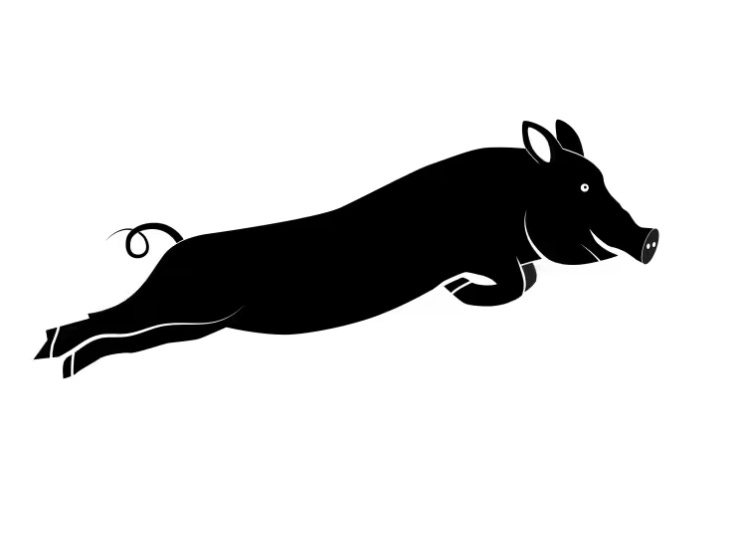
When Luau was still small, we’d lift her into the back of our pickup and drive to the lighthouse. Unlike most dogs, pigs can’t jump onto a truck’s tailgate. Their musculature is optimized for rooting, pushing, and mostly forward movement.
With a bulky torso, relatively short legs, and a range of hind-leg extension much more limited than that of dogs, vertical propulsion is extremely difficult. However, smaller, younger pigs can make impressive leaps over obstacles when sufficiently motivated, as seen in this pig-racing video.
Well cared for and well fed, Luau grew to over 300 pounds. She soon became too heavy to lift into the bed of the pickup. Because jumping wasn’t an option, I built a ramp for her to climb aboard. We certainly didn’t want her to miss out on her evening rides, nor its accompanying sensual pleasures, referred to by British philosopher John Stuart Mill as The Doctrine of Swine.
Now, we can segue from Mills’ disputation of utilitarianism, in which the “best life” is one spent pursuing pleasurable experiences, and consider how our health is impacted by immediate sensory gratifications with longer-term adverse consequences. A happy pig is one who eats their fill and rolls in mud, with no thought to the future. Must we do likewise?
Preventive Medicine’s Challenges
Much like the futility of trying to get Luau to jump, the biggest challenge for preventive medicine physicians in suggesting lifestyle interventions is how to effectively persuade patients to give up something that’s unhealthy for them, but still gives them pleasure. For some, eating whole-grain rice instead of white, or plain yogurt in place of sweetened, can seem like too much of a vertical leap.
It’s highly unlikely that people will give up something that they enjoy, or do something in which they had no previous interest, in exchange for vague assurances of future benefits. For many people, if not most, the reward of a greater health-span can seem like the promise of “pie in the sky.”
Poor health literacy adds to the challenges for preventive medicine and public health. The general state of ignorance is becoming worse as a result of online misinformation and the corruption of science by politically influenced government sources. A major culprit is the U.S. Department of Health and Human Services (HHS) under its anti-vaccine head, RFK Jr. People now have a serious problem trying to figure out who to trust.
A recent Kaiser Family Foundation (KFF) poll found that 41 percent of Americans, most of them MAGA Republians, say they support the MAHA movement. MAHA and MAGA are catchy slogans that conceal underlying political and personal agendas. Fortunately, health care affordability is a far more important issue for the MAHA acolytes than are the provably false claims being pushed by RFK Jr.
At the same time as HHS is spreading lies, the FDA has blocked the publication of studies demonstrating the safety of covid and shingles vaccines. This comes shortly after the CDC refused to publish a report showing last winter’s covid vaccine significantly reduced the likelihood of hospitalizations.
A doctor can suggest to their patient that they eat more vegetables, but too many people find that veggies aren’t nearly as tasty as junk food. Even when selections from the produce section can be paid for using free vouchers, the majority of subjects in a 2026 study were willing to pay for less healthy but more palate-pleasing foods, rather than eat the free, healthier choices. We can learn to love eating food that’s good for us, but it will likely require some serious taste-bud rehabilitation.
According to a 2021 study, every hot dog you eat can rob you of 36 minutes of a healthy life, while a handful of nuts could gain you 26 minutes. Is that kind of trade-off worth it to you? It is to me, and I am writing this in the hope that I’ll persuade people to just say “NO!” to ultra-processed and fake food. My guess is that if you weren’t interested in leading a healthier life you wouldn’t be reading this, but you probably know someone who could benefit from the information.
Of course, people are always free to define for themselves what constitutes their best “quality of life.” For some patients with diabetes, that might mean having another helping of sugar-laden ice cream, while ignoring the fact that poorly controlled blood sugar levels can eventually result in needing renal dialysis, going blind, or having their legs amputated. We’re programmed by our DNA to make choices that produce short-term results. It takes conscious effort to delay gratification in order to invest for the future.
It’s not your fault that the desire for a quick hit of pleasure is a huge impediment to making healthy choices that might only offer a long-term payoff. That’s dopamine doing its job. Our brains have been wired by evolution to deal with threats and opportunities that are immediate or immanent, because when it comes to taking action, the present moment is the only place where any action can occur. Of course, the evolutionary pressures that shaped our neurobiology took place when very few of our ancient ancestors survived to old age, and chronic illness was not an issue.
The second biggest obstacle to healthy living is that we are now surrounded by a great many unhealthy choices, all the while being barraged by skillfully designed ads persuading us to do what is most profitable for the purveyors. In order to embrace a healthy lifestyle, we must resist the brainwashing. With powerful corporations “too big to fail” and complicit politicians, the odds are stacked against us. It is little wonder that most people simply surrender to the internal and external pressures.
Consequently, it will likely require a rude awakening, wrought by a serious yet preventable illness, to strongly motivate any lifestyle changes. The question is, will those changes have come too late? I’ve seen patients who radically transformed their diet and activity level after suffering a heart attack. They no doubt increased their lifespan by doing so. But, wouldn’t it have been better if they had made those changes before the heart damage occurred?
Pulling It All Together
Giving undivided attention to our patients, although challenging, remains a necessity for providing high-quality patient care. Being present, whether it’s in the practice of medicine, or life in general, fosters greater understanding and provides increased leverage for making positive changes. There is much value in learning to focus our attention on what is here and now, while still taking appropriate action to create a better future.
Although disincentivized by America’s for-profit healthcare system, the public is growing increasingly aware of the importance of prevention. The downside is that this has resulted in a booming wellness industry, with online influencers offering expensive, pseudoscientific alternatives that are often ineffective and may even be dangerous. Consumers, beware!
We must demand affordable and accessible health care, with a solid foundation in preventive medicine. That will require the political will to reform the current system. Politicians who don’t support healthcare for all need to be voted out. These necessary changes need to occur way before American medicine reaches an evolutionary dead-end, not when pigs fly.

Post Script
When we left Kalaupapa and moved into a townhouse on the west end of Molokai, we couldn’t take Luau with us, so we gave her to the community. We assumed they would cherish her as the volunteer fire department’s mascot. Instead, they ate her, at their Christmas luau. We later learned that the “ugliest dog” of Kalaupapa turned out to be tastiest pig they ever had.
This article may be updated at any time. Please check back here again to find the latest information on this subject.
Even better, you can recommend subscribing to your family, friends, and social media followers. Free subscribers get temporary access to all paywalled articles by making referrals. Simply use the link below to encourage the people you care about to subscribe:
If you find my Newsletter to be of value, and would like to lend your support, please become a paid subscriber, or make a small donation. That will prompt Substack to promote this publication, enabling it to reach more people.
If you don’t want the benefits of a paid subscription, which include bonus newsletters, unlimited access to all paywalled articles, and a free download of the Healthy Fiber Calculator, consider making a one-time donation: