
Merry Winter Solstice
Let there be more daylight!

UPDATED: December 25, 2025
Welcome to the Healthy Living Is Good Medicine Newsletter, presenting timely, science-based, original articles covering a wide range of preventive medicine and public health topics, along with critical commentaries on the politics and economics of the American healthcare system.
Celebrating the Winter Solstice
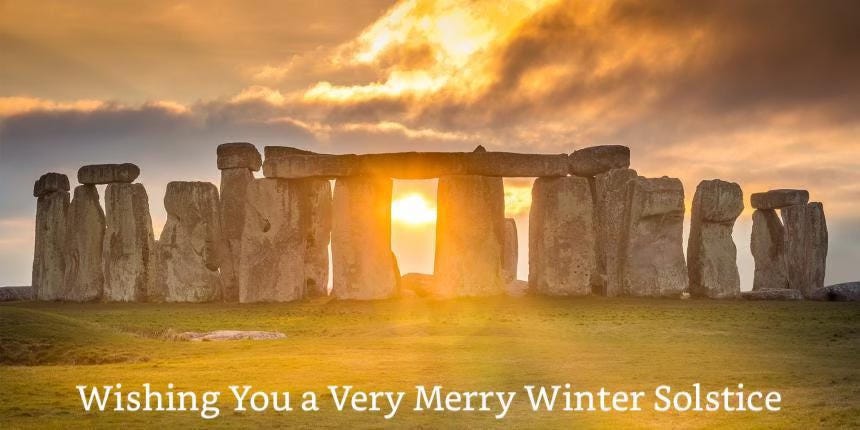
In the Northern Hemisphere, the Winter Solstice is an especially important time of year because it marks the date when there will be increasing amounts of daylight, lasting until the Summer Solstice in June. For me, that’s cause enough for celebration.
The word “solstice” is derived from the Latin, solstitium, meaning “Sun stand-still.” On the days leading up to and shortly after the Winter Solstice, the Sun’s apparent path across the sky changes very little, and it seems to rise and set at about the same time each day, creating the illusion that it has been standing still. It takes a few days after the Winter Solstice for people to notice that the length of daylight is actually increasing.
A solstice is actually an astronomical event in which a planet’s poles are at their greatest tilt toward or away from the star that it orbits. When the North Pole is at its maximum inclination away from the Sun, the Sun’s rays are reaching us at their farthest distance south, at the Tropic of Cancer. The Summer Solstice, the “longest day” of the year, occurs simultaneously in the Southern Hemisphere.
Increasing amounts of daylight following the Winter Solstice have been celebrated by people for thousands of years. The Roman Saturnalia, the Nordic and Germanic Yuletide celebrations, and the Yalda traditions of ancient Persia, are just a few examples. The Druids in the British Isles observed Alban Arthan at Stonehenge, celebrating the “death of the Old Sun and birth of the New Sun,” a triumph of light over darkness.
Obviously a cultural appropriation to attract others to their new faith, the early Christians celebrated their savior’s birth at the same time as the prevailing pagan Winter Solstice festivities. The timing of a miraculous birth, a common theme in ancient religious mythology, couldn’t have been better. Scriptures don’t mention Yeshua’s (Jesus’) birth date. A decree making the Christmas holy day December 25 was issued by the Roman Emperor Constantine in 336 CE (AD).
On the Winter Solstice, the main axis of the Stonehenge monument in England is aligned with the Sun. A modern “Sunrise at Stonehenge” Winter Solstice event is live-streamed every year on YouTube. In 2025, the Winter Solstice will occur on Sunday, December 21 at 15:03 GMT. Watch the event livestreamed from Stonehenge:
There are at least seven other ancient structures thought to commemorate the Winter Solstice: The Maeshowe burial mound in Scotland’s Orkney archipelago, the Newgrange passage tomb in Ireland, the Carnac Stones in northwestern France, the wooden Goseck Circle in Germany, the Temple of the Sun at Machu Picchu in Peru, the El Castillo pyramid in Chichén Itzá, Mexico, and the Karnak Temple Complex, in Luxor, Egypt.
I celebrated the Winter Solstice by hiking the Pacific Crest Trail in the San Bernardino Mountains of Southern California, high above the Mojave Desert. There wasn’t another human, vehicle, or habitation as far as my eye could see. There is a tremendous restorative power in nature, solitude, and silence:
I hope you enjoyed the Winter Solstice and celebrated it in a manner of your choosing. Please consider the ancient wisdom of living in synchrony with sunlight, and maximizing your outdoor daytime activities as much as possible throughout the year:

Best wishes for a Happy Holiday Season and a Very Healthy New Year,
Dr. Mick
Find more of my articles in my Post Archive.
Please share my Website Link with others via your social media accounts.
You can help your friends and followers become healthier by suggesting that they subscribe to this Newsletter. You will receive access to some premium features as a thank-you for making referrals:
End Notes: Some Ancient Winter Solstice Traditions
Saturnalia (Roman): A boisterous festival honoring the god Saturn, featuring feasting, gift-giving, candles, and evergreen decorations, reflecting themes of reversal and plenty before winter’s hardship.
Yuletide Celebration (Norse/Germanic): A midwinter festival with huge bonfires and feasting (drinking grog) to help the sun return, with Yule logs burned for days, symbolizing the burning away of the old year.
Woden Festival (Germanic): Held in honor of the god Woden (Odin), who was believed to fly through the night sky during this time.
Alban Arthan (Celtic): The “Light of Winter” celebrated by Druids as the solstice marked the turning point, welcoming the returning sun.
Imbolc (Celtic/Irish): Celebrated around February 1st (near the midpoint), this festival for the goddess Brigid involved bonfires, making Brigid’s crosses, and rituals to ensure a good growing season, as she represented the coming light and fertility.
Shab-e Yalda (Persian): A vigil celebrated on the longest night, where families stay up late, light fires, and use candles to help the sun defeat the darkness, waiting for dawn.
Soyal (Indigenous American Hopi): A winter solstice festival in Arizona where ceremonies are performed to call the sun back from its winter rest, ensuring its return and the renewal of life.