
About Black Pepper
My Very Favorite Seasoning

UPDATED: December 16, 2025
Welcome to the Healthy Living Is Good Medicine Newsletter, presenting timely, science-based, original articles covering a wide range of preventive medicine and public health topics, along with commentaries on the politics and economics of the American healthcare system.
Seasoning Foods
Modern humans have a tendency to consume too much salt in their diets, an evolutionary hold-over from prehistoric times when this important mineral was scarce. These days, when it comes to seasoning my food, I much prefer using herbs and spices to enhance the flavor, instead of adding extra salt. If you want to know why, read this:

Among all the spices, freshly-ground black pepper is my go-to seasoning for just about everything I make for lunch or supper. I’m not alone in this. Black pepper is considered to be the world’s most widely traded and eaten spice. It makes an appearance in almost every type of cuisine because of its great versatility and its ability to enhance the flavor of many staple dishes.
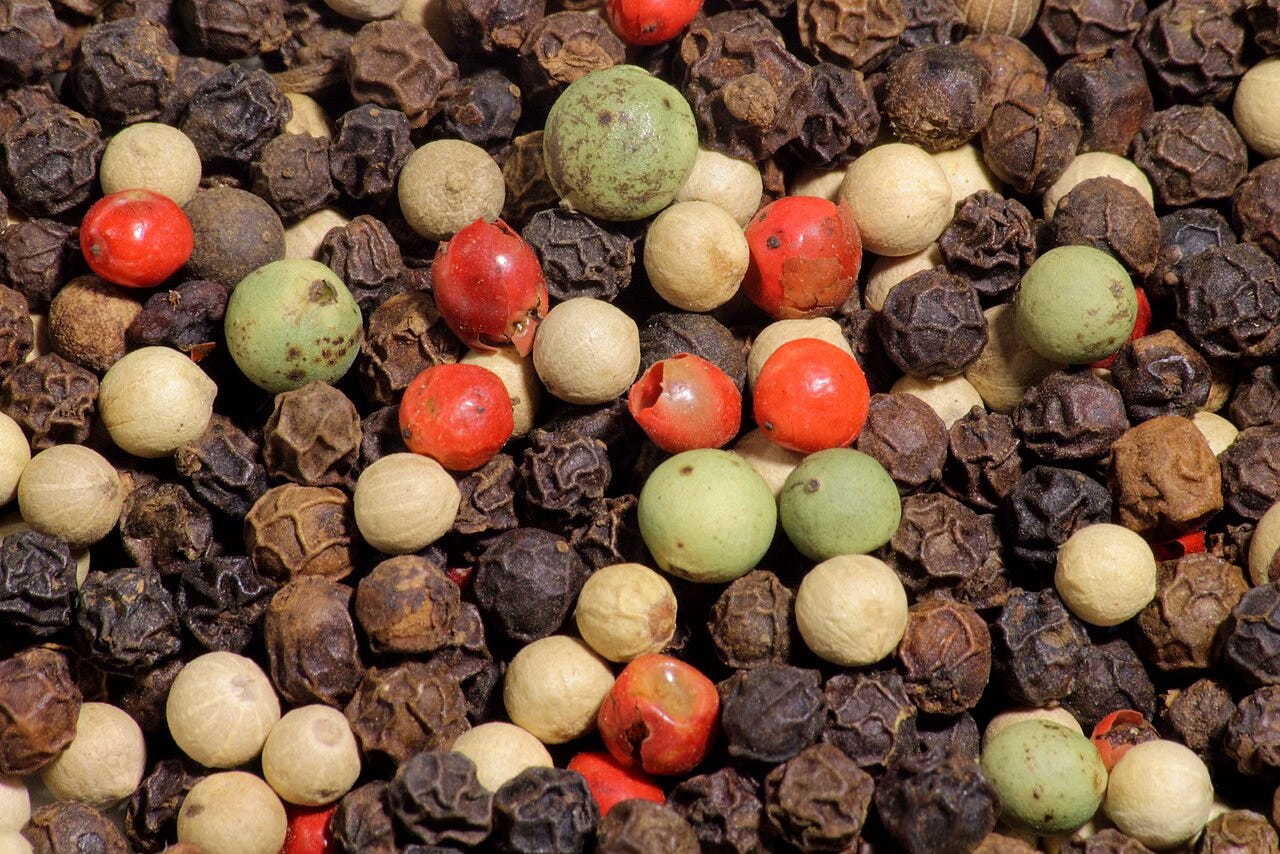
Black Peppercorns
Black peppercorns are the dried fruits of the Piper nigrum plant, a perennial woody flowering vine belonging to the family Piperaceae and native to southeast and south Asia. Black pepper is produced from the green, unripe “drupes” of the pepper plant; fleshy fruits with a thin skin and a central seed. During drying, the skin around the pepper seeds shrink and darken into a wrinkled, dark layer. White pepper is made entirely from the seeds of ripe pepper fruit, after the skin and flesh have been removed.
Black pepper’s use in cooking dates back to at least 2000 BCE in India. Today, the worldwide production of black peppercorns is led by Vietnam, followed by Brazil, Indonesia, and India.
Black pepper gets its spicy flavor primarily from piperine found in both the outer fruit and the seed. Black peppercorns contain 4.6 to 9.7 percent piperine, by weight. Pure piperine is about a hundred times less hot than the capsaicin found in chilli peppers.
Black pepper loses its flavor and aroma through evaporation when exposed to air and light. Airtight storage in the dark will help preserve its culinary appeal. Once peppeecorns are ground, the aromatics can quickly evaporate, so most recipes recommend grinding whole peppercorns immediately before use. Handheld pepper-mills or grinders should be used for this purpose. A mortar and pestle can also be used crush the peppercorns.
Let Food Be Thy Medicine
Spices have been used in traditional Indian and Chinese medicine, and as folk remedies, based upon their alleged healing properties. In more modern times, the Hippocratic school of Greek medicine used dietary regimens emphasizing whole foods and lifestyle activities as the primary therapy. Keep in mind that consuming large quantities of spices exceeding the amounts typically used for seasoning foods can have adverse effects, including interactions with some medications.
In the minuscule, “non-therapeutic doses” that are typically used for cooking, cinnamon, turmeric, ginger, and black pepper are generally considered safe, provided their purity, quality, and method of preparation meet certain standards. It is therefore best to shop for spice brands known for integrity, and to check for analyses of their heavy-metal content and other contaminants. Bulk spices from unknown or unvetted sources should be avoided, regardless of how appealing their prices may be.


Disclosure: Several AI search and summary resources were employed to find relevant information about black pepper that had been published in the scientific literature. The associated references were then reviewed. As you surely know by now, AI tools can be great servants, but lousy masters. I use them cautiously, and don’t allow them to write my articles. But don’t discard the baby along with dirty bathwater; it’s really not that hard to tell the difference.
Potential Health Benefits
Most of black pepper’s potential benefits can be derived from regular dietary consumption, rather than taking mega-doses. While black pepper is generally considered safe as a spice, the large amounts of piperine that are often found in dietary supplements cannot be recommended.
Black pepper is claimed to have numerous health benefits due to the potential antioxidant, antidiabetic, anti-obesity, antihypertensive, anti-inflammatory, anticancer, hepatoprotective, and neuroprotective properties of piperine. However, most of the supporting evidence is based upon cell cultures and laboratory animal experiments. There is clearly a need for more human studies employing randomized, controlled trials. References are at the very bottom of this article.
Piperine stimulates the release of pancreatic digestive enzymes, and can increase stomach acid production, potentially improving digestion, while also having gastro-protective properties. Some research suggests it may increase nutrient absorption by slowing intestinal transit time, while also helping to prevent diarrhea.
Bioavailability enhancement represents a particularly important property of piperine, since it significantly increases the absorption and bioavailability of various therapeutic drugs and phytonutrients. Mechanisms of action include inhibiting hepatic and intestinal drug-metabolizing enzymes, modulating intestinal transporters such as glycoproteins, and modifying intestinal brush border cellular structure. Piperine has been shown to increase bioavailability of the curcumin found in turmeric by up to 2,000 percent, which is why black pepper and turmeric are often used together in Asian cooking.
The antioxidant and anti-inflammatory effects of piperine are well-documented. Piperine increases serum superoxide dismutase levels while reducing malondialdehyde and C-reactive protein in individuals with metabolic syndrome. It protects against cellular oxidative damage by scavenging free radicals and reactive oxygen species, and also enhances production of cellular antioxidant enzymes.
Metabolic benefits include improved lipid profiles, with studies showing reductions in total cholesterol, LDL cholesterol, and triglycerides in overweight and obese individuals. Piperine has demonstrated potential antidiabetic properties, and may help reduce insulin resistance. It may also affect energy expenditure and contribute to fat loss in overweight individuals.
There is also some evidence to suggest that piperine might have neuro-protective effects and improve functioning in people with age-related neurodegenerative disorders. Piperine has also demonstrated anti-inflammatory properties in laboratory animal studies, and might have cardiovascular protective properties and antimicrobial effects against certain pathogens. It may even have potential benefits for osteoarthritis and liver disorders.
With all these possible health benefis, along with enhancing the flavor of many foods, I see no reason not to have a pepper mill on my dining table. How about you?
May you enjoy a healthy and happy holiday season, and have a wonderful year ahead. As we are now in the “season for giving,” might I suggest making a “gift of health” by recommending this newsletter, and ordering some of my books.
― ― ―
This Post may be updated at any time. Please check back here again to find the latest information on this subject.
Find a lot more of my articles about Healthy Living in my Post Archive.
Please share my Website Link with others via your social media accounts. You can help your friends and followers become healthier by suggesting that they subscribe to this Newsletter. You will receive access to premium features as a thank-you for making referrals:
References

Bioactive Properties, Bioavailability Profiles, and Clinical Evidence of the Potential Benefits of Black Pepper and Red Pepper Against Diverse Metabolic Complications.
Dludla PV, Cirilli I, Marcheggiani F, et al.
Molecules (Basel, Switzerland). 2023;28(18):6569.
doi:10.3390/molecules28186569.
https://pmc.ncbi.nlm.nih.gov/articles/PMC10534530/

Piperine: A Review of Its Biological Effects.
Haq IU, Imran M, Nadeem M, et al.
Phytotherapy Research : PTR. 2021;35(2):680-700.
doi:10.1002/ptr.6855.
https://pubmed.ncbi.nlm.nih.gov/32929825/

A Systematic Review on Black Pepper: From Folk Uses to Pharmacological Applications.
Takooree H, Aumeeruddy MZ, Rengasamy KRR, et al.
Critical Reviews in Food Science and Nutrition. 2019;59(sup1):S210-S243.
doi:10.1080/10408398.2019.1565489.
https://pubmed.ncbi.nlm.nih.gov/30740986/

Piperine- A Major Principle of Black Pepper: A Review of Its Bioactivity and Studies.
Zorica Stojanović-Radić, et al.
Applied Sciences, 9(20):4270 (2019).
doi.org/10.3390/app9204270
https://www.mdpi.com/2076-3417/9/20/4270
Summarizes clinical studies where piperine enhanced curcuminoid bioavailability and improved respiratory health outcomes.

Piperine and Its Role in Chronic Diseases.
Derosa G, Maffioli P, Sahebkar A.
Advances in Experimental Medicine and Biology. 2016;928:173-184.
doi:10.1007/978-3-319-41334-1_8.
https://pubmed.ncbi.nlm.nih.gov/27671817/

Black Pepper and Its Pungent Principle-Piperine: A Review of Diverse Physiological Effects.
Srinivasan K.
Critical Reviews in Food Science and Nutrition. 2007;47(8):735-48.
doi:10.1080/10408390601062054.
https://pubmed.ncbi.nlm.nih.gov/17987447/
Comprehensive review documenting how piperine stimulates digestive enzymes, protects against oxidative damage, and enhances bioavailability of therapeutic drugs and phytochemicals.

Black Pepper and Health Claims: A Comprehensive Treatise.
Butt MS, Pasha I, Sultan MT, et al.
Critical Reviews in Food Science and Nutrition. 2013;53(9):875-86.
doi:10.1080/10408398.2011.571799.
https://pubmed.ncbi.nlm.nih.gov/17987447/
Reviews antioxidant, antimicrobial, anti-inflammatory, and gastro-protective properties, noting that piperine assists in cognitive brain functioning and nutrient absorption.

Therapeutic Spectrum of Piperine for Clinical Practice: A Scoping Review.
Yadav SS, Singh MK, Hussain S, et al.
Critical Reviews in Food Science and Nutrition. 2023;63(22):5813-5840.
doi:10.1080/10408398.2021.2024792.
https://pubmed.ncbi.nlm.nih.gov/34996326/

Piper Nigrum and Piperine: An Update.
Meghwal M, Goswami TK.
Phytotherapy Research : PTR. 2013;27(8):1121-30.
doi:10.1002/ptr.4972.
https://pubmed.ncbi.nlm.nih.gov/23625885/

Neuroprotective Effects of Black Pepper and Its Bioactive Compounds in Age-Related Neurological Disorders.
Balakrishnan R, Azam S, Kim IS, Choi DK.
Aging and Disease. 2023;14(3):750-777.
doi:10.14336/AD.2022.1022.
https://pmc.ncbi.nlm.nih.gov/articles/PMC10187688/
This review, documenting black pepper’s neuroprotective properties, including antioxidant, antidiabetic, anti-obesity, and effects on age-related neurological disorders, shows that black pepper’s major bioactive neuroprotective compounds, such as piperine, effectively prevent symptoms and pathological conditions by modulating cell survival signaling and death.

Phytochemistry and Therapeutic Potential of Black Pepper [Piper nigrum (L.)] Essential Oil and Piperine: A Review
Kaliyaperumal Ashokkumar, et al.
Clinical Phytoscience, Volume 7, article number 52, (2021)
doi: 10.1186/s40816-021-00292-2
https://link.springer.com/article/10.1186/s40816-021-00292-2
Reviews the botany, phytochemical constituents, and pharmacological properties of piperine and black pepper essential oil and the hepatoprotective, antioxidant, anticancer, antibacterial, anti-inflammatory, and other biological effects.